
Type IL Cement and Concrete Bleeding Rates
Did you know concrete bleeding rates are more closely tied to cement fineness than limestone content?
Many users blame limestone or other SCMs for poor bleeding performance in blended and limestone cements. But the real driver? Cement fineness and particle size distribution!
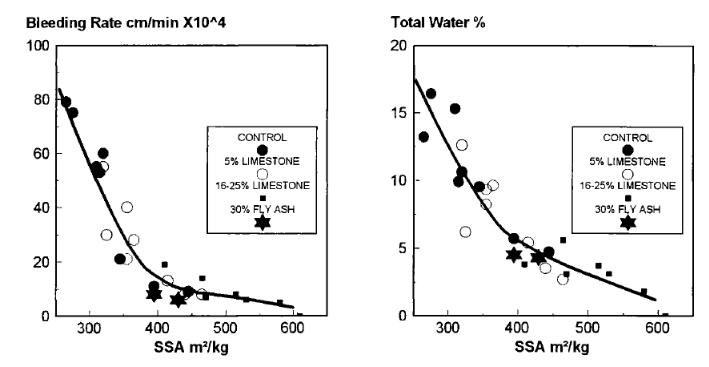
The influence of specific surface area on bleeding rate (Moir and Kelham, 1997)
Here’s what the data shows:
- Higher cement fineness increases water demand and reduces bleeding in concrete, regardless of limestone content.
- Optimising particle size distribution, especially reducing the overgrinding of clinker, can dramatically improve performance.
- Performance enhancing grinding additives can allow for coarser grinding at equal or better strengths.
- Mill residence time, ventilation, and separator efficiency are key parameters in determining the final particle size distribution
- Limestone does not act as a disruptor when used correctly.
How Chryso Can Help
Chryso’s performance enhancing grinding additives are designed to enable coarser grinding at equal or better strength performance and to boost mill output.
Our technical team has the process expertise to help you optimise your milling circuit.
References
PCA R&D SN3148 – https://www.cement.org/wp-content/uploads/2024/06/2024-SN3148.03.pdf
Moir, G. K. and Kelham, S., “Developments in the Manufacture and Use of Portland Limestone Cement,” ACI Special Publication SP 172-42, 1997, pages 797 to 819.